Abundant America
The Playbook for Local Abundance
A guide for local leaders to restore trust in how their communities make decisions: starting with the outcomes residents want and measuring every proposal against them — part of a broader effort to evolve Abundance from a strong policy critique into a full politics, one capable of shaping America's political landscape for the better.
Bring the Playbook to my community →
Why start with outcomes?
In an environment of low institutional trust, the goal of the Playbook for Local Abundance is to begin to restore trust in the civic processes that shape a community's future — anchoring the political discussion in tangible outcomes desired by the community and the opportunity to share in the value growth creates. The Playbook seeks to flip the process: start by asking what people want to achieve, commit to measure decisions and proposals against how well they deliver on those desired outcomes, while being honest and transparent about tradeoffs.
Historically, American politics ran on the shared agreement that growth was good. Local leaders could propose a project and explain the details afterwards because communities were expected to trust that investment would reach them, that jobs would be created and community value captured. That consensus no longer exists. The fall of the neoliberal political order has left us in a moment between political moments without a shared framework of agreement to anchor decision making. Communities have seen growth happen without seeing its benefits reach them on the ground level, eroding the implicit trust that underpinned that model.
Who it's for
Local leaders doing the hard, slow, patient work to make their communities a better place to live, work, raise a family or start a business.
How this approach is different
The Playbook gives local leaders a simple framework to lead through, creating a stable, proactive posture for evaluation and decision making rather than a constant reactive one. The mechanics and processes of local politics built over the past decades often work against starting with outcomes, forcing local leaders to be constantly reactive to incoming proposals or necessary decisions.
In many communities, proposals for new housing or infrastructure are brought to permitting or zoning boards first. By the time community members hear about them, local leaders are forced to take reactive positions without a clear way to measure and explain their support or opposition. Support and opposition have often hardened, and it is too late to bridge the gap with facts and information.
How it works
Four steps to decisions communities can trust
1/ Listen first
Start with what works in your community. This can mean simple listening sessions and town halls that explicitly ask what goals community members hold and what outcomes would be appealing, or extend to in-person events, surveying local Facebook groups and community boards. The goal is to reach a broader number of residents and hear what your community actually wants as the starting point.
2/ Set outcomes together
Translate your constituents' inputs into achievable goals for your community, and engage them in the process. Make the outcomes visible to the public — whether through a public forum, dashboard or other mechanism — showing transparency and commitment to community concerns.
3/ Screen proposals
Commit to evaluate new proposals and decisions against how well they achieve the community goals set above, while being transparent and public about trade-offs. This re-establishes trust in a shared agreement, rather than advancing an agenda set by those who did not engage the people directly affected by it.
4/ Set a direction
Share the outputs; use them to guide decisions and spending, and also build a transparent narrative that anchors those investments in community objectives and the real, agreed-upon trade-offs required to achieve what constituents want for their families and their future.
Putting the Playbook to work
A process that starts with outcomes can help you lead through tough decisions
The point is not to support every project automatically. It is to help communities define the outcomes they need and want, measure proposals against how well they deliver those outcomes, and discuss trade-offs transparently, distinguishing between projects that merely extract value and projects that create broadly shared prosperity. That moves the conversation toward practical questions:
- —What does this community want to achieve?
- —What would make a proposal genuinely good for this place?
- —What would make our community a better place to live, work, raise a family, or start a business?
- —How can public process improve decisions rather than merely delay them?
- —How do residents see their priorities reflected in what gets decided?
- —How do we get better at talking about trade-offs?
- —How can communities shape growth so they share in its benefits?
Hands-on support for local leaders
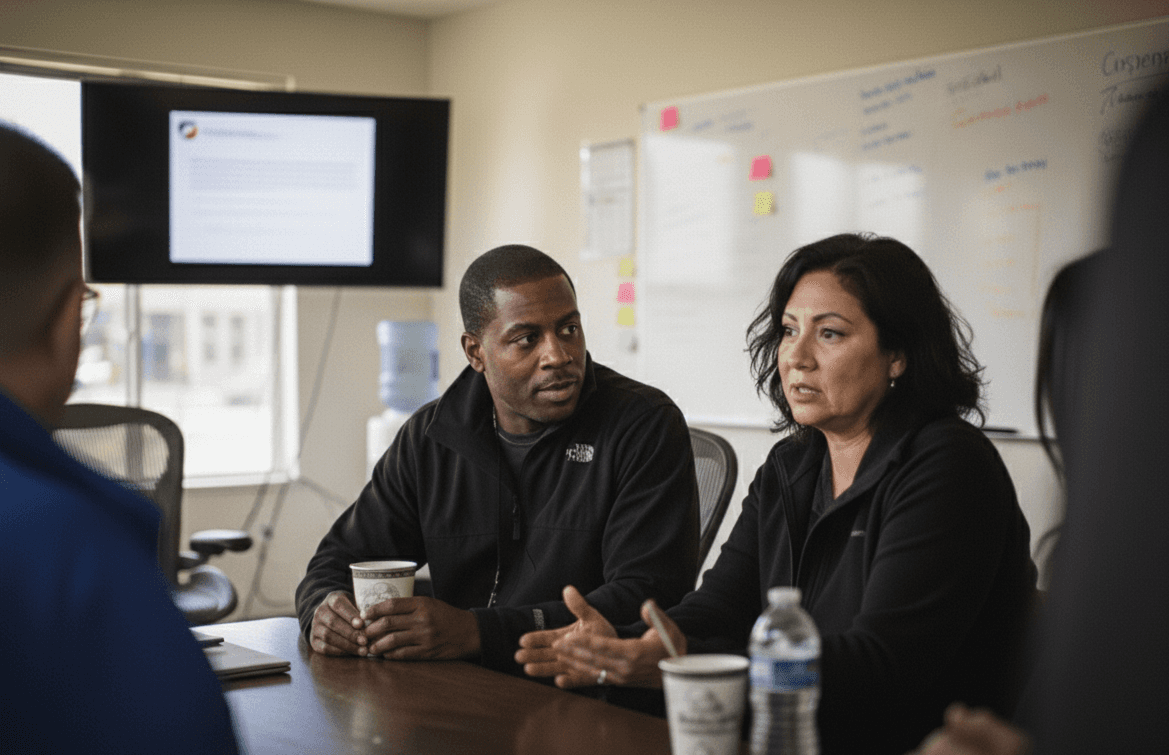
We work directly with local leaders to adopt and run the Playbook in their own communities. It is deliberately lightweight: it works wherever leaders face consequential decisions, and it does not require a local coalition to already exist.
Shared language for civic engagement
The outcomes a community sets give civic groups, labor, local businesses and elected officials a common reference point for working together, so decisions rest on a shared, public understanding of what the community wants.
Community participation in the value of growth
When communities define the outcomes they want before proposals arrive, investment and community benefit commitments can be measured against those outcomes and reported publicly, giving residents a genuine stake in the value that growth creates.
Bring it to your community
Decisions your community can see itself in
If your community is facing consequential decisions about its future, or you feel constantly reactive to proposals without a clear way to weigh them against what your constituents want, Abundant America can help you bring the Playbook for Local Abundance to your town, district, or county.